


When it comes to Raspberry Pi, most developers and enthusiasts still regard it merely as a teaching and prototyping single board computer. Few would associate it with demanding online industrial vision inspection scenarios.
Leveraging GMSL global shutter imaging modules, GMSL to MIPI deserializer adapters and a layered vision processing architecture paired with computing accelerator cards, ALG-TECH enables the Raspberry Pi 5 to meet the requirements of high speed image acquisition on industrial production lines. It delivers a stable, reliable image source and preliminary analysis capabilities for appearance defect inspection.
Application Scenarios
Automated online inspection on production pipelines: As the line runs, a tracking module captures workpiece position signals in real time and sends trigger signals. Cameras must capture frames instantly and precisely for product appearance recognition and defect detection.
Why Raspberry Pi? What Are the Project Challenges?
For pipeline industrial vision inspection, X86 industrial PCs are the established mainstream hardware solution. However, such systems suffer from large footprint and high hardware costs.
Advantages of Raspberry Pi for Industrial Deployment
Compared with traditional X86 industrial PCs, the ARMbased Raspberry Pi features compact size and low power consumption. It fits easily inside confined line side equipment and cuts thermal and mechanical design costs. Backed by a mature open source ecosystem, developers can directly call vision libraries such as OpenCV to shorten development cycles. Its lower BOM cost delivers an even more pronounced cost advantage when deployed in bulk across multi station production lines.
Nevertheless, the native Raspberry Pi platform has notable limitations. After evaluation, the main bottlenecks fall into three categories: interface, imaging and computing power.
· Interface: Unlike X86 platforms that readily connect to industrial Ethernet cameras, the Raspberry Pi 5 only features MIPI CSI ports. Native ports do not support long range industrial cameras; MIPI signals have short transmission distances and poor noise immunity.
· Imaging: It cannot natively work with global shutter cameras, making it hard to capture fast moving workpieces on pipelines. Motion blur frequently occurs, and consistent high quality images cannot be guaranteed.
· Computing power: Vision recognition is computationally intensive. If the Raspberry Pi 5 alone handles high speed image capture, heavy preprocessing and AI inference, its on board CPU, GPU and memory bandwidth will be heavily overloaded. Sustained real time performance cannot be guaranteed. An external accelerator card is required to run recognition algorithms locally on the embedded platform.
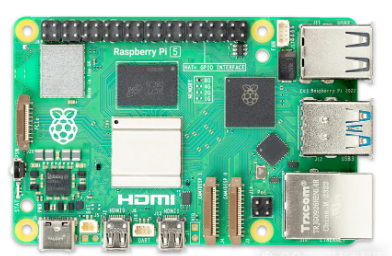
Raspberry Pi 5 Board
To meet project requirements, ALG-TECH has built a custom Raspberry Pi solution with full adaptation at the hardware, driver, communication and scheduling API layers. The Raspberry Pi is transformed into a lightweight industrial vision acquisition unit capable of high speed pipeline inspection as an alternative to selected X86 industrial PCs.
ALG-TECH Custom Solution
In this architecture, the Raspberry Pi 5 acts as the main controller. It runs the OS, loads V4L2 drivers, manages camera settings, responds to external triggers, orchestrates image data flow and communicates with upper level business systems.
The GMSL to MIPI Raspberry Pi HAT sits between the camera link and host. It deserializes high speed serial image signals, converts protocols and adapts MIPI interfaces.
The accelerator card connects to the Raspberry Pi 5 via a high speed interface. It offloads compute heavy vision workloads that would otherwise overwhelm the CPU and GPU. This keeps the host lightly loaded and focused on real time control and data streaming.
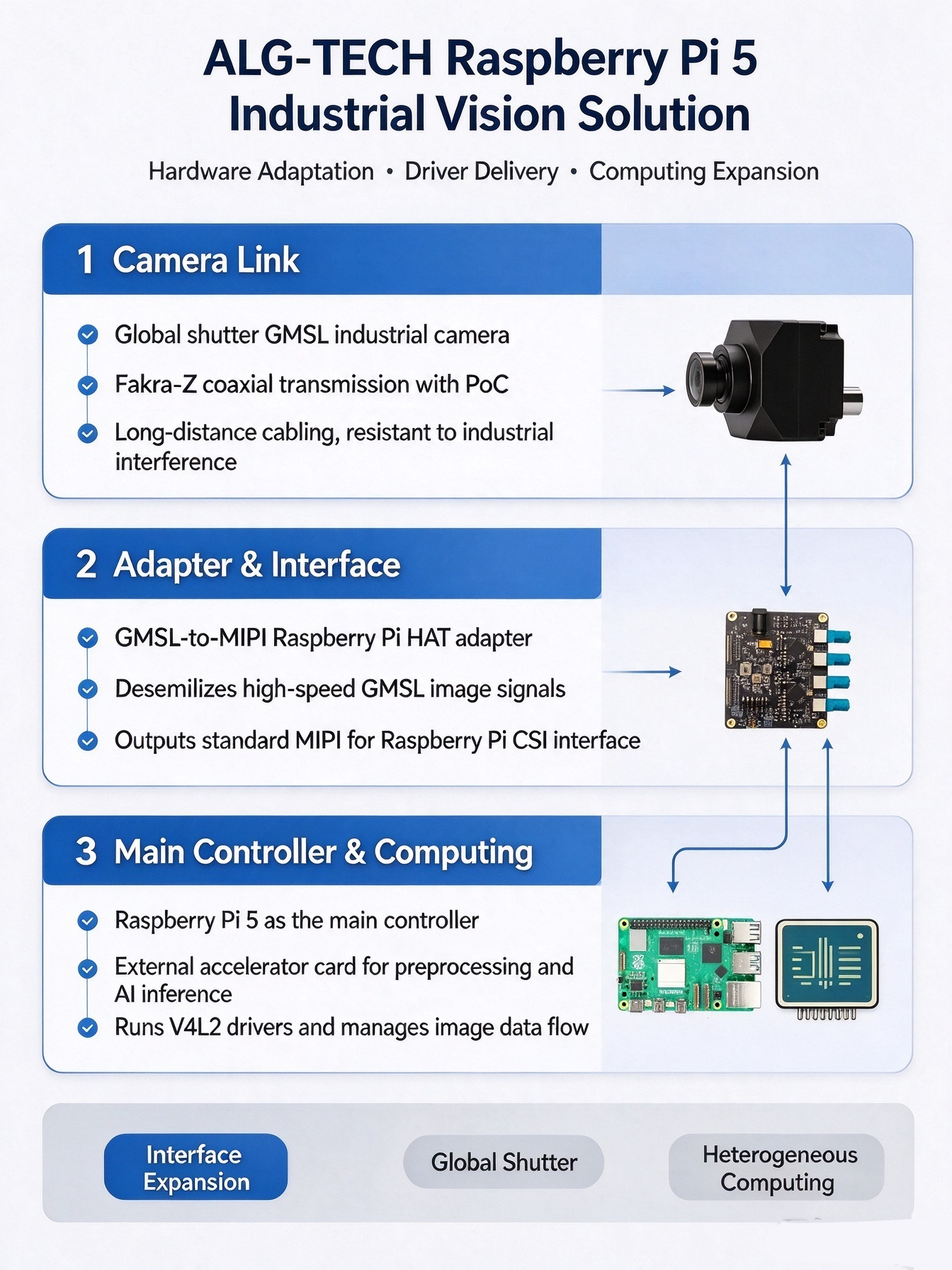
Hardware
1. GMSL to MIPI Raspberry Pi HAT Adapter
Standard HAT form factor for direct plug in with Raspberry Pi. Supports single or dual GMSL camera inputs with a choice of mainstream industrial deserializer chips. It features an optically isolated M8 industrial trigger port to suppress electrical noise on the factory floor for dependable trigger signals. It outputs standard MIPI signals and comes with DTBO device tree configurations for plug and play operation.
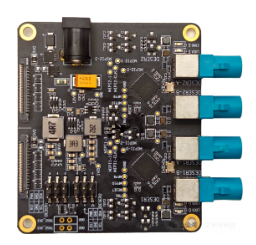
ALG-TECH Raspberry Pi 5 GMSL Adapter Kit (Standard Version)
1. Global Shutter GMSL Industrial Camera Module
Equipped with a high frame rate global shutter image sensor and Fakra Z industrial coaxial connector. It supports PoC (Power over Coax), carrying both image data and power over one cable to greatly simplify on site wiring. Built on accumulated automotive grade R&D experience, the product is strictly controlled across component selection, reliability validation and mass production processes. It delivers stable performance and consistent batch quality. The industrial mechanical design offers vibration resistance, EMI robustness and stable operation across wide temperatures. It suits high speed line inspection, robotic picking and machine vision tasks in harsh workshop environments, meeting industrial real time acquisition demands.
2. Accelerator Card Expansion Unit
As a heterogeneous computing node in the system, the accelerator card connects to the Raspberry Pi 5 over a high speed data channel. It takes on compute heavy vision tasks, lowering CPU usage and memory bandwidth pressure on the Pi. This improves real time responsiveness and stability under continuous high frame rate capture.
Software & Driver Delivery
ALG-TECH’s custom stack is deeply optimized for Raspberry Pi and conforms to the V4L2 standard. All camera parameters can be configured through the coaxial cable. Customers focus on inspection algorithms without massive investment in low level driver development.
Core Solution Value
1. Lower hardware barrier: Turn Raspberry Pi into an industrial vision host There is no need to replace expensive X86 industrial PCs. Using the customer’s Raspberry Pi host, the adapter adds GMSL industrial camera capability and keeps total BOM cost under control.
2. Global shutter eliminates motion blur on fast lines Global shutter and high frame rate capture prevent distortion caused by rolling shutters when imaging fast moving workpieces, ensuring sharp frames for defect inspection.
3. Microsecond level high precision hardware triggering for reliable capture Low jitter, high precision triggering synchronizes perfectly with line tracking signals. The camera fires the instant a workpiece arrives. Multiple cameras can run independent capture to easily expand multi view inspection.
4. GMSL coaxial transmission for long factory cabling runs Fakra Z cables carry both image and power. Long transmission distance and strong anti interference performance simplify field wiring for complex industrial environments.
5. Complete software package drastically cuts project lead time Heterogeneous offloading on the accelerator card handles heavy computation. The host stays lightly loaded, avoiding frame drops, added latency and unstable responses caused by algorithm scheduling. Long term real time performance and reliability are enhanced.
6. Complete software package drastically cuts project lead time Standard V4L2 drivers plus full development documentation free engineers from deep low level driver work. Business algorithms can be developed rapidly, accelerating prototype development and pilot validation.
This combined stack of Raspberry Pi, GMSL global shutter cameras and accelerator cards offers a viable technical route for projects needing lightweight, cost effective embedded industrial vision. ALG-TECH provides custom development of GMSL/MIPI camera modules, deserializer adapters and heterogeneous computing expansion units. We deliver integrated hardware and driver solutions for Raspberry Pi and other embedded platforms, serving industrial vision customers worldwide.